
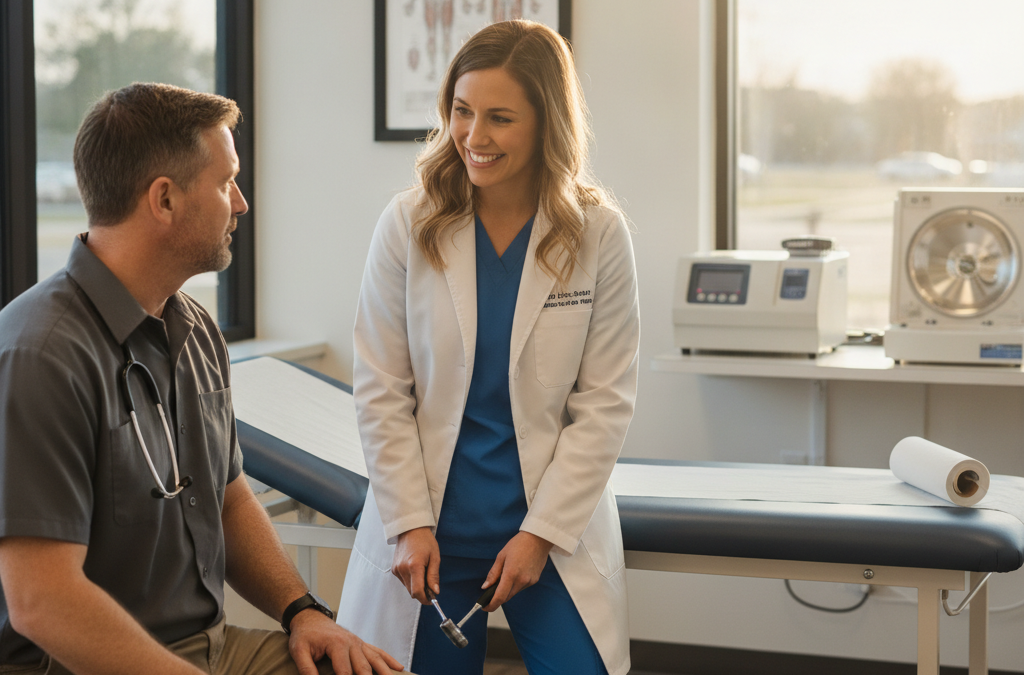
How Do Return-to-Work Exams Work in Brook Park — and What Do Employers and Injured Workers Need to Know?
When an employee has been out due to a workplace injury or illness, getting them safely back on the job isn’t as simple as saying “feel better, see you Monday.” A return-to-work exam — sometimes called a return-to-duty or work clearance evaluation — is often the bridge between recovery and resuming normal duties. In Brook Park and across Cuyahoga County, employers in manufacturing, logistics, airport operations, and other physically demanding industries rely on these exams to protect both the worker and the workplace. Here’s a plain-language breakdown of what the exam involves, who needs one, and how to make the process as smooth as possible for everyone.
What Is a Return-to-Work Exam — and Is It the Same as a Fit-for-Duty Exam?
You may hear these two terms used almost interchangeably, but there’s a useful distinction. A return-to-work exam typically follows a specific incident — a workplace injury, surgery, or extended illness — and focuses on whether an employee is medically ready to resume their regular job duties, modified duties, or some combination of both. A fit-for-duty exam is broader and can be ordered at any point when there’s a reasonable, job-related concern about an employee’s ability to safely perform their role.
In practice, both involve a licensed medical provider reviewing the employee’s current physical condition against the specific demands of their job. For a forklift operator in a North Olmsted warehouse, that means something very different than it does for a desk-based administrative employee. The provider’s job isn’t to make a judgment call about the person — it’s to match the medical picture to the work requirements and document that clearly.
Who Typically Needs a Return-to-Work Exam in the Brook Park Area?
In this part of Northeast Ohio, the workers most likely to need return-to-work clearance are those in physically demanding roles — think airport ground crew, cargo handlers near Cleveland Hopkins, assembly line workers in Brook Park’s manufacturing sector, and commercial drivers and logistics employees who operate along the busy I-480 and I-71 corridors. A slip-and-fall in an icy Cuyahoga County parking lot in January, a strain from a repetitive motion on the warehouse floor, or a post-surgery recovery can all lead to time away from work — and a formal clearance exam before coming back.
Employers in Berea, Middleburg Heights, and Parma face similar situations. When a worker has been on modified duty or medical leave, having documentation from a medical provider gives HR teams and supervisors something concrete to work from — both for compliance and for the employee’s own protection.
What Happens During the Exam Itself?
The exam is a medical evaluation, not an interrogation. The provider will typically review the employee’s injury or illness history, any treatment records or specialist notes, current symptoms or limitations, and the specific physical requirements of the job. For many roles, employers provide a job description or physical demands analysis — a document listing things like how much lifting is required, whether the job involves repetitive motion, exposure to heights or heavy machinery, and so on.
Based on that review, the provider will determine one of a few outcomes: the employee is cleared to return to full duty, cleared to return with restrictions or modified duties for a defined period, or not yet medically ready to return. The provider will document their findings and communicate clearly with both the employer and the employee.
If on-site imaging is needed — say, to check healing on a fracture or confirm a musculoskeletal concern — having on-site X-ray available at the same visit saves everyone the hassle of sending the worker to a separate imaging center and waiting days for results.
What Should the Employee Bring to the Appointment?
A little preparation goes a long way. Injured workers should bring:
- A valid photo ID
- Any treatment records, physical therapy notes, or specialist discharge paperwork from their recovery
- A list of current medications
- The employer’s return-to-work or modified duty form (if provided by HR)
- The job description or physical demands summary, if the employer has one
- Workers’ comp claim information, if applicable
The more context the provider has going in, the more precise and useful the clearance documentation will be. Showing up empty-handed doesn’t disqualify anyone, but it can slow down the process or require a follow-up visit.
What the Employer’s Role Looks Like — and Where Most Businesses Get Tripped Up
This is the section that most competitor clinic websites gloss over, and it’s where small businesses often run into real problems. Many HR managers in Parma or Brook Park assume that a return-to-work exam is just a formality — the worker shows up, the doctor signs off, everyone moves on. But if the process isn’t set up correctly from the employer’s side, it can create liability gaps or miscommunication that costs more to untangle later.
A few things employers should have ready before sending an employee for clearance:
- A written job description with physical demands — vague descriptions like “light duty” aren’t enough. List specific weights, motions, durations, and environmental conditions.
- A clear modified duty offer letter — if you’re offering transitional or light duty, put it in writing so the provider and the employee both know exactly what’s being offered.
- A designated HR or supervisor contact — the clinic may need to ask a follow-up question or send paperwork. Make it easy for them to reach the right person.
- A timeline expectation — same-day clearance is possible for straightforward cases; more complex situations may require additional records or a follow-up appointment.
Employers who coordinate directly with an occupational medicine provider before the visit — rather than just sending an employee in cold — consistently get faster, cleaner results.
How Does This Connect to Workers’ Comp?
Return-to-work exams and workers’ compensation cases often overlap. If an employee was treated for a work injury under a workers’ comp claim, the return-to-work clearance is typically part of wrapping up that claim or documenting the transition back to duty. Having the exam and the documentation handled in the same clinical setting where the injury was originally evaluated — or at a clinic familiar with Ohio workers’ comp paperwork — keeps everything organized and reduces the back-and-forth that HR teams dread.
Frequently Asked Questions
How long does a return-to-work exam take?
Most straightforward evaluations take 30 to 60 minutes, especially when the employee brings complete documentation. If imaging or additional testing is needed, it can be done the same visit at our Brook Park clinic, which typically keeps the total appointment under two hours.
Does the employer or the employee pay for the exam?
In most cases, the employer covers the cost of return-to-work exams, particularly when the absence was related to a workplace injury. If it’s connected to an open workers’ comp claim, coverage may flow through that claim. We encourage employers and employees to call us to clarify billing before the appointment.
What if the provider says the employee isn’t ready to return yet?
The exam result is a medical recommendation, not a disciplinary action. If the provider determines that an employee needs more recovery time or specialist follow-up, they’ll document that clearly and may recommend a follow-up clearance date. This protects both the worker and the employer from a premature return that leads to reinjury.
Can a CDL or commercial driver get a return-to-work clearance at the same visit as their DOT physical?
These are two separate evaluations with different purposes and paperwork, but in many cases they can be scheduled back-to-back on the same day to minimize time off the road. Call ahead so we can plan accordingly.
Does Nextdoor Urgent Care handle return-to-work paperwork for employers in Parma and Berea, not just Brook Park?
Yes. We serve employers and workers throughout Cuyahoga County, including Parma, Berea, North Olmsted, Middleburg Heights, and the greater Cleveland area. Walk-ins are welcome, and we’re easy to reach off Snow Road.
Get Your Employee Back to Work — Without the Runaround
At Nextdoor Urgent Care & Primary Care on Snow Road in Brook Park, we handle return-to-work exams with the same straightforwardness we bring to every occupational health service — clear documentation, efficient scheduling, and providers who understand what local employers actually need. Whether you’re an HR manager in Parma coordinating a team member’s return after a winter slip-and-fall, or an employee who’s ready to get back on the floor and just needs the paperwork to prove it, we’re here to make that process simple.
Walk in or call us at (216) 385-0281 to schedule. You can also reach out online to set up an employer account or ask about coordinating occupational health services for your team. This article is for informational purposes only and is not a substitute for professional medical or legal advice specific to your situation.