
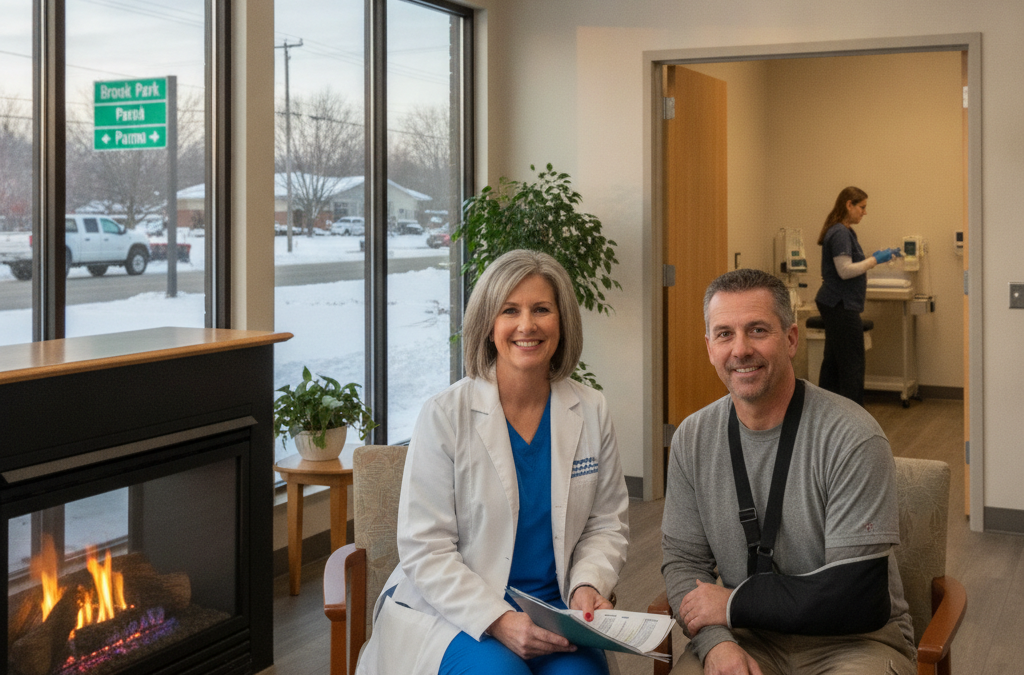
What Happens During a Fit-for-Duty Exam for Cold-Weather Work Injuries in Parma and Brook Park?
When icy parking lots, frozen loading docks, and snow-covered outdoor worksites send a Parma or Brook Park employee to the clinic with a sprain, fracture, or back strain, the injury is only the first chapter. The second — and sometimes harder — chapter is getting cleared to safely return to work. A fit-for-duty exam is what bridges those two moments. It tells both the employee and the employer that the worker has recovered enough to do their job without putting themselves or their coworkers at risk. Here’s what that process actually looks like, why it matters more than many workers realize, and what local employers in Cuyahoga County should have in place before winter injuries start piling up.
Why Winter Specifically Drives Work Injury Claims in This Region
Northeast Ohio winters are not abstract. When temperatures drop along the I-480 and Brookpark Road corridors, the slip-and-fall risk in parking lots, on loading docks, and around airport ground operations climbs sharply. The Cleveland Hopkins airport district, the manufacturing facilities scattered through Brook Park and Middleburg Heights, and the warehouses and logistics hubs that line the area’s industrial corridors all share the same cold reality: wet concrete, black ice, and rushed foot traffic in heavy gear create conditions where ankle rolls, wrist fractures, shoulder injuries from catching a fall, and lower back strains happen quickly and often.
These aren’t minor inconveniences. A warehouse associate who slips on an icy dock can easily strain a shoulder, a knee, or a lumbar disc. A ground crew worker near Hopkins who catches himself on frozen tarmac may have a wrist fracture that looks like a sprain. The initial treatment — whether that’s imaging, splinting, or a referral — is handled at the time of injury. But the question that follows weeks later, when the employee says they feel ready to come back, is a different one: are they actually ready to do their specific job safely?
What a Fit-for-Duty Exam Actually Involves
A fit-for-duty evaluation is a focused medical assessment designed to answer one clear question: can this person perform the essential physical functions of their job without unreasonable risk of re-injury or harm to others? It’s not a general physical, and it’s not simply a provider signing off because a patient says their pain is gone.
Depending on the job and the injury, a fit-for-duty exam at Nextdoor Urgent Care & Primary Care may include:
- A review of the injury history and any treatment or imaging already completed
- A physical assessment of the injured area — range of motion, strength, stability, tenderness
- On-site X-ray if there’s a question about how well a fracture or sprain site has healed
- A functional review against the actual job demands (lifting limits, standing duration, climbing, gripping)
- Documentation of any work restrictions, if a full return isn’t yet appropriate
The result is a written clearance document or a modified-duty recommendation — not just a verbal thumbs-up. That paperwork matters for HR, for workers’ comp records, and for the employee’s own protection.
The Gap Most Employers Miss: Linking the Injury, the Job Description, and the Exam
Here’s something that large urgent care chains and hospital systems rarely address clearly in their employer-facing content: a fit-for-duty exam is only as useful as the information the employer provides going into it. If the examiner doesn’t know what the job physically requires — how much lifting, what kind of repetitive motion, whether the employee works outdoors on uneven surfaces — the clearance they issue is essentially generic.
Local employers in Parma, North Olmsted, Berea, and the airport district who work with Nextdoor Urgent Care & Primary Care can communicate job task information directly. That means the provider reviewing your employee can match the physical findings to the actual demands of a ramp agent, a machine operator, a forklift driver, or a package handler — not just a theoretical average worker. This is a practical step that makes return-to-work decisions cleaner and reduces the risk of a re-injury that sends everyone back to square one.
If you’re an HR manager or a safety coordinator and you haven’t yet built out a simple physical job description for your highest-risk roles, now — before the icy months hit — is the time to do it. It doesn’t need to be elaborate. A one-page outline of lifting requirements, environmental conditions, and physical demands is enough to make a meaningful difference in what a provider can tell you.
What Workers Should Bring to a Fit-for-Duty Appointment
If you’re a worker in Brook Park or Cuyahoga County who’s been off after a cold-weather injury and your employer is asking for clearance before you come back, the visit goes smoother when you bring:
- Any prior imaging reports or X-ray results from your initial injury visit
- Documentation of any treatment you received — physical therapy notes, splint or cast removal records
- Your employer’s return-to-work form or clearance paperwork, if they gave you one
- A list of your current medications, especially anything you’re taking for pain
- Your photo ID and insurance card or workers’ comp claim information
You don’t need to call ahead for a workers’ comp or fit-for-duty visit — walk-ins are welcome. But if you have paperwork from your employer that specifies what the exam needs to cover, bring it. That paperwork tells the provider exactly what your job requires and what your employer needs documented.
What Happens If You’re Not Quite Ready to Return Full Duty
Not every fit-for-duty exam ends with an unconditional full-duty release, and that’s not a failure — it’s the system working the way it’s supposed to. If you’re not yet fully healed, the provider may issue a modified-duty or light-duty clearance that specifies what you can and can’t do safely right now. For many Cuyahoga County employers, modified duty is a practical option that keeps workers engaged and productive while protecting them from re-injury.
If a question comes up about healing progress — whether a fracture site looks fully consolidated, for example — on-site X-ray services at Nextdoor Urgent Care mean you don’t need to schedule a separate imaging appointment and wait days for results. The imaging happens the same visit, and the provider interprets the results in context of the exam findings.
A Note on Serious Symptoms
Fit-for-duty exams address musculoskeletal recovery and job-specific function. If a worker is experiencing chest pain, numbness or weakness spreading beyond an injury site, difficulty breathing, or any symptom that feels like a medical emergency, those situations require emergency care — call 911 or go to the nearest ER immediately. Urgent care is the right setting for work injury follow-up and return-to-work clearance, not for acute emergencies.
Frequently Asked Questions
How long does a fit-for-duty exam take in Brook Park?
Most fit-for-duty visits take between 30 and 60 minutes, depending on the complexity of the injury and whether on-site imaging is needed. Walk-ins are welcome, though bringing your paperwork and prior records helps move things along.
Who pays for a fit-for-duty exam — the employee or the employer?
When a fit-for-duty exam is part of a workers’ comp claim, it is typically covered through the workers’ comp process. If the exam is employer-initiated outside of a workers’ comp claim, the employer generally pays. Call us at (216) 385-0281 to confirm how your specific situation should be handled before your visit.
Can my employer require a fit-for-duty exam before I come back after a winter injury?
Yes. Employers in Ohio can require a fit-for-duty evaluation before allowing a return to safety-sensitive or physically demanding work, particularly after a documented workplace injury. This protects both the worker and the employer.
What if I had my initial injury treated somewhere else — can I still get my fit-for-duty exam at Nextdoor Urgent Care?
Absolutely. Bring whatever records, imaging, or treatment notes you have from your original care. The provider will review your history and conduct a current assessment of your functional status.
Does Nextdoor Urgent Care handle workers’ comp paperwork for Parma and Brook Park employers?
Yes. We work with employers throughout Cuyahoga County — including Parma, Middleburg Heights, Berea, North Olmsted, and the airport district — on workers’ comp evaluations, return-to-work documentation, and fit-for-duty clearances. Employers can call ahead to discuss how to set up a referral relationship for their team.
Get Your Team — or Yourself — Back to Work Safely
Winter work injuries are part of life in Northeast Ohio. What doesn’t have to be complicated is the path from injury to clearance. Whether you’re a Parma warehouse supervisor trying to get a team member back on the floor, an HR coordinator at a Brook Park manufacturing facility building out your return-to-work process, or a worker who just needs a provider to look at your shoulder and sign off so you can get back to your shift — Nextdoor Urgent Care & Primary Care is here for that.
Walk-ins are welcome. Contact us or call (216) 385-0281 to speak with our team, confirm your insurance coverage, or ask about employer account setup for ongoing occupational health needs. We’re on Snow Road in Brook Park — close to the people and businesses we serve.
This article is for informational purposes only and does not constitute medical or legal advice. For work-related injuries or medical questions specific to your situation, please consult a qualified healthcare provider.