
How Do Pre-Employment Drug Tests Work in Parma — and What Should Job Applicants Expect on Testing Day?
You just received a conditional job offer — congratulations. But now there’s a next step: a pre-employment drug test, and the clock is ticking. If you’re a job applicant in Parma, Brook Park, or anywhere in the greater Cleveland area, you might have a lot of questions and not a lot of time to find reliable answers. What exactly happens at the appointment? Do you need to make a reservation? What if you’re on a prescription medication? This guide gives you a straightforward, honest walkthrough of the entire process — from the moment you get the referral form to the moment your results reach your employer.
What Is a Pre-Employment Drug Test, and Why Do Employers Require It?
A pre-employment drug test is a screening that many employers require before officially bringing a new hire on board. It’s typically a condition of the job offer — meaning the offer stands only if the test result meets the employer’s standards. In the greater Cuyahoga County area, industries like logistics, manufacturing, transportation, healthcare, and airport-adjacent services are among the most common sectors requiring this screening. Given the concentration of warehousing, freight, and industrial employers near the I-480 corridor and the Cleveland Hopkins airport district, pre-employment drug testing is a routine part of the hiring process for a significant share of local workers.
The test itself is usually a urine drug screen — though some employers require hair follicle testing, oral fluid testing, or a breath alcohol test depending on the role and industry. For most standard pre-employment situations, urine is the default. At Nextdoor Urgent Care & Primary Care, we handle employer-ordered drug testing for both applicants and companies, with walk-in availability and fast turnaround so you’re not left waiting for days just to move forward with your new job.
What to Bring to Your Drug Test Appointment
This is one of the most common areas where applicants arrive unprepared — and it can cause delays. Here’s what you typically need:
- A valid government-issued photo ID. A driver’s license, state ID, or passport will work. The collection site is required to verify your identity before collecting a specimen.
- Your employer’s drug testing order or referral form. This is the document your employer or HR department gives you. It tells the collection site what type of test to run and where to send the results. Without it, the collection site may not be able to complete the test.
- A list of any prescription medications you are currently taking. You don’t have to hand this to the collector, but you should have it available. If a prescription medication shows up in your results, the Medical Review Officer (MRO) process allows you to provide documentation — but more on that below.
You do not need to fast, and you do not need to drink excessive amounts of water before your test. Overhydrating before a urine drug screen can actually dilute the sample and trigger a requirement to retest, which delays the process.
Step-by-Step: What Actually Happens During the Visit
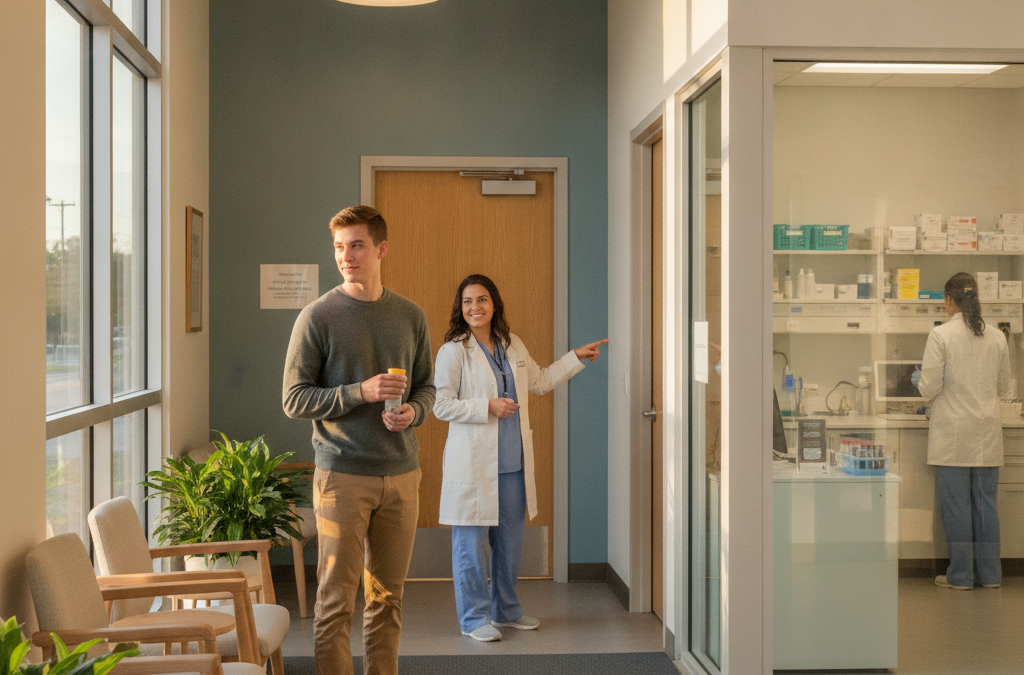
A lot of applicants feel nervous going into a drug test simply because no one has walked them through it. Here’s what the visit typically looks like at a walk-in collection site like ours in Brook Park:
- Check in and present your ID and employer order. The front desk will confirm your information and document the chain of custody — a formal process that ensures the integrity of the specimen from collection to lab.
- Complete a short form. You’ll typically fill out a custody and control form (CCF) that asks for basic information. The collector will walk you through it.
- Provide a urine specimen. You’ll be directed to a private restroom. The collector will not be in the room with you for a standard non-observed collection. The restroom may be prepared in advance (water shut off, blue dye in the toilet) to ensure specimen integrity.
- Specimen is sealed and documented in front of you. The collector will check the temperature and seal the specimen in your presence. You’ll both sign the chain of custody form to confirm the process was completed correctly.
- You’re done. The whole process usually takes 15 to 30 minutes, depending on wait time. The specimen goes to a certified lab for analysis.
How Long Does It Take to Get Results — and Where Do They Go?
This is the part that competitors’ websites tend to gloss over, and it’s where applicants are most likely to be left in the dark. Here’s the honest breakdown:
A negative result — meaning no substances were detected above the cutoff levels — typically comes back within 24 to 72 hours for a standard urine screen. Some results come back faster. Results go directly to the employer or a third-party administrator (TPA) the employer uses — not to you, unless your employer’s process includes notifying you directly.
If the initial screen shows a potential non-negative result, the specimen is sent for a confirmatory test called GC-MS (gas chromatography-mass spectrometry), which takes additional time. Before a non-negative result is reported to your employer as a positive, a licensed Medical Review Officer (MRO) will contact you. The MRO is a physician who reviews all non-negative results and gives you the opportunity to provide a legitimate medical explanation — such as a valid prescription for a medication that appeared in the panel. This is an important safeguard that many applicants don’t know exists.
What If You Take Prescription Medications?
This is probably the most anxiety-producing question applicants have, and it deserves a clear answer. A valid prescription for a medication is not automatically disqualifying. The MRO process exists specifically to review cases where a prescription medication may explain a non-negative result. When the MRO calls you, be prepared to provide the name of the prescribing physician and pharmacy. The MRO evaluates that information and, if legitimate, may report the result as negative to the employer.
That said, we cannot predict outcomes, and individual circumstances vary. If you have concerns about a specific prescription and a pending drug test, speaking with your prescribing provider in advance is a reasonable step.
A Note on Alcohol Testing
Standard pre-employment urine drug screens do not typically test for alcohol. However, some employers — particularly in safety-sensitive roles governed by federal regulations — may require a separate breath alcohol test. If your employer’s order includes alcohol testing, that will be noted on the referral form, and the collection site will conduct it as a separate step using a breathalyzer device.
Walk-In Drug Testing Near Parma and Middleburg Heights
If you’re coming from Parma, Parma Heights, Middleburg Heights, or Berea, Nextdoor Urgent Care & Primary Care is conveniently located on Snow Road in Brook Park — just a short drive from the I-480 and I-71 interchange. We accept walk-ins for drug testing, so you don’t need an appointment to get started. Our staff handles collection professionally and respectfully — we understand that for most applicants, this is just a required step between you and your new job, and we want to make it as quick and stress-free as possible. Learn more about our occupational medicine and employer services if your new employer also needs to set up an ongoing drug testing program.
Frequently Asked Questions
Can I walk in for a pre-employment drug test at Nextdoor Urgent Care in Brook Park, or do I need an appointment?
Walk-ins are welcome for drug testing. You’ll want to bring your employer’s drug testing order, a valid photo ID, and any information about current prescriptions in case the MRO needs to reach you. Call ahead at (216) 385-0281 if you have questions about what your specific order requires.
How long will I wait for results after my drug test in Parma or Brook Park?
A negative result typically comes back to your employer within 24 to 72 hours of collection. Non-negative results that go through confirmatory testing and MRO review take longer. Timelines can vary based on the lab and whether the MRO review process is needed.
Does the drug test result go to me or directly to my employer?
Pre-employment drug test results are reported directly to your employer or their designated third-party administrator (TPA). If the MRO needs to contact you to discuss a non-negative result, they will reach out to you directly before reporting a final result to the employer.
What if I’m on a prescription medication that might show up on the test?
The Medical Review Officer (MRO) review process is designed to handle exactly this situation. If a prescription medication causes a non-negative initial screen, the MRO will contact you to review your documentation before any result is finalized. Having your prescribing doctor’s information and pharmacy details ready is helpful.
Can employers in Parma or Cleveland require different types of drug tests?
Yes. While urine testing is by far the most common, some employers — particularly in safety-sensitive or federally regulated industries — may require hair follicle, oral fluid, or breath alcohol tests. Your employer’s referral form will specify what type of test is required. If you’re not sure what to expect, call us and we’ll help clarify.
Ready to Get Your Drug Test Done Today?
If you’ve received a drug test referral from a new employer in the Parma, Cleveland, or Brook Park area, don’t let the process slow down your start date. Walk in to Nextdoor Urgent Care & Primary Care at 15900 Snow Rd, Suite 302, Brook Park — or call us at (216) 385-0281 to confirm we have your test type available. We’ll handle the collection quickly, professionally, and with the respect your time deserves. Visit our contact page for directions, hours, and any questions before your visit.
This content is provided for informational purposes only and is not a substitute for professional medical or legal advice. Drug test results depend on individual circumstances and are subject to the policies of the requesting employer and the reviewing MRO. Nextdoor Urgent Care & Primary Care does not guarantee specific test outcomes.