
What Should Parma and Brook Park Employers Know About OSHA Recordkeeping After a Workplace Injury?
If one of your workers gets hurt on the job — a slip on an icy loading dock in Parma, a strain on a warehouse floor near Hopkins, a laceration on a production line in Brook Park — the first priority is always getting them safe and evaluated. But within hours or days of that injury, your business also has paperwork responsibilities that many small and mid-size employers in Cuyahoga County don’t fully understand until something goes wrong. OSHA recordkeeping requirements are federal law, and failing to comply — even accidentally — can result in citations, fines, and audit exposure. This guide is here to help you understand what you’re required to do, what documentation to gather, and how a local occupational medicine provider can make the process straightforward.
What Is OSHA Recordkeeping — and Does It Apply to Your Business?
OSHA’s recordkeeping rule (29 CFR Part 1904) requires most employers with 10 or more employees to maintain records of serious work-related injuries and illnesses. These records are kept on three core forms: the OSHA 300 Log (a running list of recordable incidents), the OSHA 301 Injury and Illness Incident Report (details about each incident), and the OSHA 300A Summary (posted annually each February through April).
Some lower-hazard industries are partially exempt, but manufacturing, warehousing, logistics, transportation, and construction — all well-represented in the Brook Park and Parma area — are generally fully covered. If you’re unsure whether your business is exempt, OSHA’s website has an industry lookup tool, or you can speak with your occupational medicine provider for general guidance.
What Makes a Workplace Injury “Recordable”?
This is where many employers get tripped up. Not every injury requires an OSHA record, but more incidents qualify than most people expect. An injury is recordable if it results in any of the following:
- Days away from work
- Restricted work duties or job transfer
- Medical treatment beyond first aid
- Loss of consciousness
- Diagnosis of a significant injury or illness by a healthcare professional
The tricky part is the phrase “beyond first aid.” OSHA defines first aid very specifically — it includes things like over-the-counter medications at nonprescription strength, bandaging, and one-time visits to a healthcare professional for observation. If your employee needs prescription medication, sutures, physical therapy, or any follow-up care, the injury likely crosses into recordable territory. That’s why getting a proper clinical evaluation on day one matters — not just for your employee’s recovery, but for your documentation.
Why the Medical Visit Creates Your Paper Trail — and Why It Needs to Be Done Right
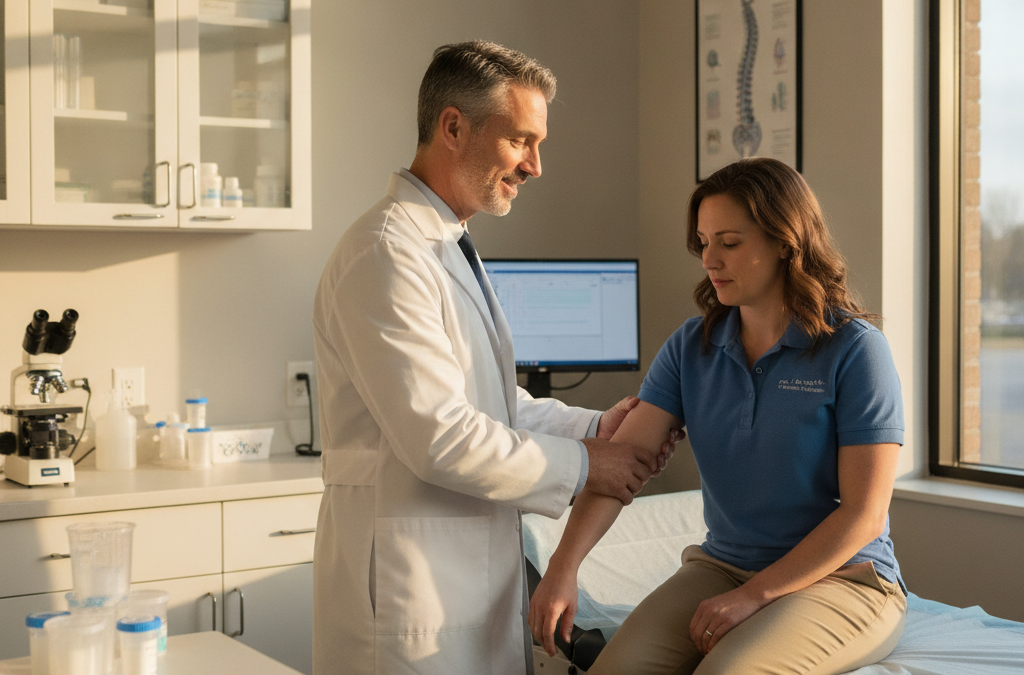
When an injured worker visits a clinic, the treating provider documents the nature of the injury, the treatment given, any work restrictions, and whether follow-up is needed. That documentation becomes the foundation of your OSHA record. It also drives your workers’ compensation claim, any modified-duty or return-to-work plan, and your defense if the injury is ever disputed.
This is an area where the choice of clinic matters more than employers often realize. Large hospital systems can generate records that are thorough but hard to parse — written for clinical purposes, not employer compliance. Generic urgent care chains may treat the injury but offer little support for the paperwork that follows. A clinic with dedicated occupational medicine experience understands that you need clear work status language, restriction documentation, and a point of contact for follow-up — not just a discharge summary.
At Nextdoor Urgent Care & Primary Care on Snow Road in Brook Park, work injury evaluations include clinical care plus the documentation employers in the airport corridor, logistics sector, and industrial parks of Cuyahoga County need to stay organized and compliant. Workers can walk in without an appointment, and providers communicate clearly about work status so you’re not left guessing.
The Gap Competitors Miss: Explaining What Happens Between the ER Visit and the OSHA Log
If you search for OSHA recordkeeping guidance on most large urgent care or health system websites, you’ll find either nothing or a very brief mention that work injuries should be reported. What’s almost never explained is the practical middle ground: what documentation to request from the treating clinic, how to determine whether an injury crosses the “recordable” threshold, and how to handle the gray areas — like an employee who returns to light duty the next day but still received prescription-strength anti-inflammatories.
These are the questions that local HR managers in Parma, Middleburg Heights, and Fairview Park are actually searching for, and they deserve clear, practical answers. Here’s a quick framework:
- At the time of treatment: Request a work status note from the treating provider. It should state whether the employee can return to full duty, modified duty (with specific restrictions), or no work. Keep this for your files.
- Within 7 calendar days: Complete the OSHA 301 form for any recordable incident. You have 7 days from learning of the incident to do so.
- Ongoing: Update the OSHA 300 Log whenever the employee’s status changes — additional days away, return to work, or change in restrictions.
- By February 1 each year: Post the OSHA 300A summary in a visible location for employees.
Modified Duty, Return-to-Work, and Why the Clinic Matters for Employers
One of the most practical cost-control strategies for employers dealing with a work injury is modified duty — keeping an injured employee working in a reduced or different capacity while they recover. But modified duty only works if the treating provider gives you specific, usable restrictions. Vague notes like “light duty” create confusion and liability.
When you work with a clinic experienced in occupational medicine, return-to-work documentation is built into the process. Providers can specify lifting limits, standing tolerances, and whether the employee can operate equipment — the kind of detail that lets a production supervisor in Brook Park or a warehouse manager in Berea actually make a staffing decision. If you need a formal workers’ comp evaluation or a return-to-work clearance exam as the employee heals, that’s also available without sending them across town.
Cold-Weather Work Injuries and Northeast Ohio’s Industrial Landscape
It’s worth noting that in Northeast Ohio, the OSHA recordkeeping calendar runs year-round — but incident volume tends to spike in winter. Icy parking lots, cold-stiffened muscles, reduced visibility, and slippery surfaces around loading docks along the I-480 and I-71 corridors create real exposure for employers in the region. The airport district around Brook Park alone employs thousands of workers in logistics, ground handling, and cargo operations, many of whom work outdoors or in environments where cold, wet conditions are part of the job.
Planning ahead means knowing where injured workers will go, having a clinic relationship established before an incident happens, and training supervisors on what documentation to request at the time of treatment. Getting that system in place in October — not January — saves time and scrambling when injuries actually occur.
Frequently Asked Questions About OSHA Recordkeeping for Cuyahoga County Employers
Does a workers’ comp claim automatically make an injury OSHA-recordable?
No. Workers’ comp and OSHA recordability are separate systems with different criteria. An injury can be recordable without a workers’ comp claim, and vice versa. Talk to your occupational medicine provider and your insurance carrier separately for guidance on each.
What if the employee says they don’t want the injury reported?
OSHA recordkeeping is an employer obligation, not an employee choice. If the injury meets the recordable criteria, you are required to log it. However, OSHA also prohibits you from discouraging employees from reporting injuries — so the process should be straightforward and non-punitive.
How do I know if our clinic is sending me the right documentation?
At minimum, you should receive a document that states the date of the visit, the nature of the injury, the treatment provided, and the employee’s work status with any restrictions. If you’re not getting that consistently, it may be worth switching to a clinic that handles occupational cases routinely. Feel free to contact Nextdoor Urgent Care & Primary Care to ask about their employer documentation process before an injury happens.
Are there OSHA exemptions for small businesses in Ohio?
Businesses with 10 or fewer employees at all times during the previous calendar year are partially exempt from routine OSHA recordkeeping, though they must still report severe injuries (hospitalizations, amputations, loss of an eye) to OSHA directly. Some lower-hazard industries also have partial exemptions. When in doubt, verify your status at OSHA.gov or consult with an occupational health professional.
Can an urgent care clinic handle the entire work injury process?
For most non-emergency work injuries — strains, sprains, lacerations, contusions, suspected fractures — yes. A clinic with on-site X-ray, laceration repair capability, and occupational medicine experience can evaluate the injury, begin treatment, provide work status documentation, and coordinate follow-up care. Life-threatening injuries or anything involving severe trauma should go to the emergency room or call 911 immediately.
Ready to Get Your Employer Process in Order?
You don’t need a large HR department or a corporate occupational health contract to handle work injuries the right way. What you need is a reliable local clinic that understands employer documentation, provides fast walk-in access for injured workers, and communicates clearly about work status and restrictions. Nextdoor Urgent Care & Primary Care, located on Snow Road in Brook Park, serves employers throughout Parma, North Olmsted, Middleburg Heights, Berea, Fairview Park, and the broader Cuyahoga County area.
Call us at (216) 385-0281 or visit our contact page to talk with our team about setting up an employer account, understanding our work injury documentation process, or simply knowing where to send employees when an incident happens. It’s the kind of conversation that’s much easier to have before someone gets hurt.
This article is for informational purposes only and does not constitute legal or regulatory advice. For guidance specific to your business’s OSHA obligations, consult OSHA.gov or a qualified occupational health or legal professional.